Orthopedics — Total Hip Replacement

Latitud™

A cementless femoral stem designed for stable fixation, anatomical versatility and preservation of proximal femoral bone.

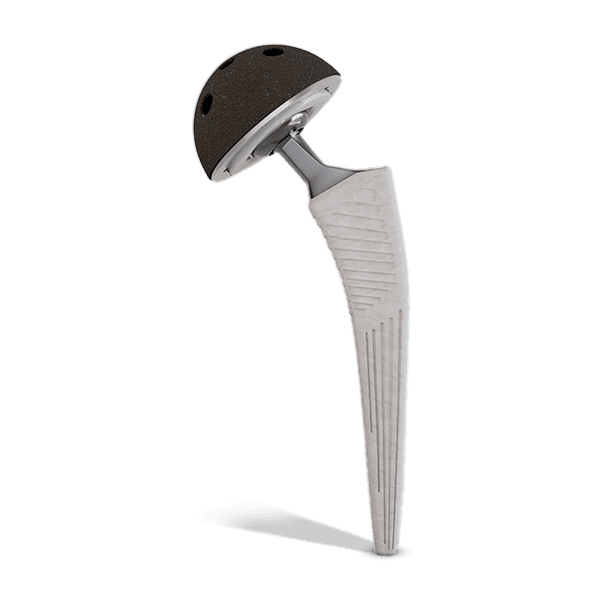
The Latitud™ Hip Replacement System includes a press-fit femoral stem engineered for cementless total hip arthroplasty. Its double-tapered titanium alloy geometry combines hydroxyapatite coating with dedicated proximal grooves to promote initial stability and efficient load transfer within the femur.

A range of stem sizes and neck configurations allows the surgeon to adapt reconstruction to different femoral anatomies while maintaining compatibility with modular femoral heads through a standard 12/14 taper.
Latitud Hip Replacement System

The system

Cementless fixation designed around proximal femoral stability

The cementless femoral stem is manufactured from Ti-6Al-4V ELI titanium alloy, a material specified for surgical implant applications.

Its double-tapered geometry is intended for press-fit insertion into the prepared femoral canal without the use of bone cement. The stem surface incorporates a plasma-sprayed hydroxyapatite coating designed to support biological interaction with the surrounding bone.

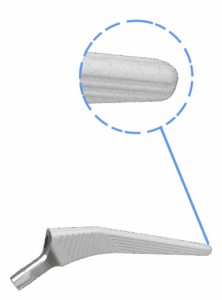
Vertical and horizontal grooves are incorporated into the stem geometry to contribute to rotational and axial stability after implantation.

Key Features

Features designed to support stability, mobility and bone preservation

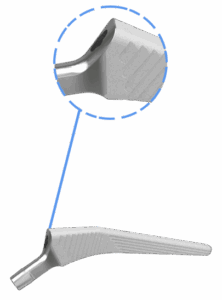
The proximal stem geometry combines a low-profile neck and shoulder with dedicated metaphyseal features intended to support range of motion, preserve proximal bone and provide stable cementless fixation.

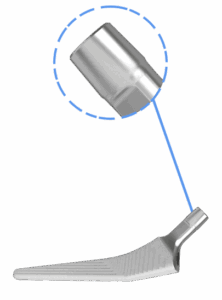
Low-profile polished neck

Low-profile polished neck

The reduced-profile polished neck increases the available head-to-neck ratio. This geometry provides greater clearance during hip motion and is intended to reduce the potential for neck-to-component impingement.

Low-profile shoulder

Low-profile shoulder

The low-profile shoulder reduces implant bulk around the greater trochanteric region. Its geometry is intended to preserve proximal femoral bone and facilitate stem insertion through tissue-sparing surgical approaches.

Metaphyseal fixation and proximal grooves

Metaphyseal fixation

The proximal metaphyseal flare is designed to engage the proximal femur and support load transfer in this region. Horizontal grooves contribute to axial stability, while vertical grooves complement the tapered stem geometry to support rotational stability.

Indication

Total hip replacement

Total hip arthroplasty replaces damaged articular structures of the hip with prosthetic components. During the procedure, the affected femoral head and acetabular joint surfaces are reconstructed to relieve pain and restore joint function.

Hip replacement may be considered in patients with severe joint damage associated with conditions such as degenerative arthritis, inflammatory arthritis or other disorders affecting the hip when appropriate non-operative treatment no longer provides sufficient relief.

Selection of components, fixation method and surgical technique must follow the applicable Instructions for Use, approved indications and local regulatory requirements.

Total hip arthroplasty

Product details

Specification ledger

PRODUCT : Latitud™ Hip Replacement System

CATEGORY : Orthopedics · total hip replacement

STEM MATERIAL : Ti-6Al-4V ELI titanium alloy

MATERIAL STANDARDS : ASTM F136 · ISO 5832-3

FIXATION : Cementless press-fit

STEM GEOMETRY : Double-tapered design with vertical and horizontal grooves

COATING : Plasma-sprayed hydroxyapatite

HA COATING STANDARD : ISO 13779-2

HEAD CONNECTION : 12/14 tapered male trunnion for modular femoral head

STEM SIZES : 0 · 1 · 2 · 3 · 4 · 5 · 6 · 7 · 8 · 9 · 10

NECK OPTIONS : 135° standard · 135° lateralized · 125° standard

REGULATORY : US FDA 510(k) clearances include K172857 and K183532

AVAILABILITY : Product configurations and approved indications may vary by region. Refer to the applicable local labeling and Instructions for Use.